Like any good Midwesterner, the weather is top of mind most of the time, especially in the depths of winter. Like the stock market, there is no such thing as experiencing average temperature – just a combination of above-average and below-average. Right now, many of us are experiencing above-average temperatures and likely our first ‘false spring’. When digital assets are in a drawdown phase from their highs, it is said to be in a ‘crypto winter’, complete with many false springs and widely varying opinions. Let us examine a few reasons why we are where we are, and what could happen next.
Sources: Carson Investment Research, Factset
What’s Ailing Crypto?
-
Technology!
Yes, I know that sounds good, as cryptocurrency, in many ways, is technology – digital assets, after all – but recent advancements in artificial intelligence have plagued software stocks. New AI tools that look to supplant existing, long-standing software platforms have led to a sizeable downturn in many software stocks, and another leg down in cryptocurrencies. The connections between software and crypto are sometimes obvious and other times hard to connect, but there has undoubtedly been a connection lately. The same AI tools could impact certain digital asset ecosystems or make their existing barriers to entry much lower. On top of this, there remains a long-standing concern that quantum computing may have the ability to seriously impact the viability of the cryptography that underpins a lot of digital assets and their security. While quantum computing is generally seen as a long way off, the pace of technological advancement is unrelenting, and even the slightest news can have an impact.
-
Macroeconomy
Crypto is almost always considered just about as far out on the “risk spectrum” as you can get from an asset class. Because of this, any need for liquidity or de-risking of portfolios in aggregate can create volatility. Whether warranted or not, there has been a lot of macro activity so far this year, and crypto has likely paid the liquidity price. Not to mention, investors have been enamored with precious metals and other related trades – it’s likely some of this money has come out of “digital gold”.
In addition, Kevin Warsh has been nominated to be the next Fed chair – one of the most hawkish candidates considered. While the expectation is not that the Fed will raise interest rates anytime soon, a substantially lower interest rate environment that would generally be supportive of crypto seems unlikely.
-
Crypto Ecosystem
Bitcoin tends to move in a four-year cycle, related to the ‘halving’ of its block rewards approximately every four years. This tends to be three solid years, followed by a pullback in the fourth year. The last pullback year was 2022, putting 2026 in the crosshairs. Of course, crypto doesn’t follow the calendar, but it is possible that certain investors are getting ahead of this potential, and selling begets more selling. There have also been concerns that large long-term holders of Bitcoin (aka Strategy Inc, inc formerly Microstrategy) would be forced to liquidate BTC to maintain proper liquidity. Strategy holds 714k BTC, worth nearly $48 Billion.
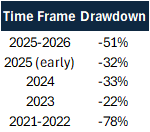
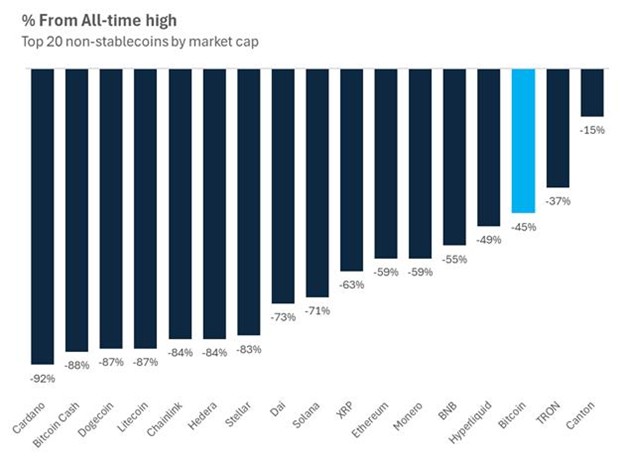
The drawdown in Bitcoin from all-time highs, as mentioned earlier, is substantial and in line with past declines, but this gets even worse across major cryptocurrencies. Many of these names, with large market caps and user bases, are down substantially from their tops.
Sources: Carson Investment Research, Coinmarketcap 2/11/2026

Stay on Top of Market Trends
The Carson Investment Research newsletter offers up-to-date market news, analysis and insights. Subscribe today!
"*" indicates required fields
What is different this time? ETFs.
Each crypto winter will be looked at differently following the substantial assets held in cryptocurrency ETFs. ETFs affect the market in a couple of ways – they make it much easier for both retail and large institutional investors to buy crypto, and they also make it easier to sell. They also affect liquidity – crypto never stops trading, whereas crypto ETFs trade for only 6.5 hours a day, 5 days a week. While it may not seem like much, especially given how most investors are used to market hours, the ETF trading window is less than 20% of the trading time of spot crypto! This can lead to off-hour liquidations as a result of ETF flows, at times when liquidity is low, and markets could potentially move more than expected. Just this year, we have seen several experiences where overnight or over the weekend, the crypto market sold off, rebounded by morning, but ETFs had to ‘catch-up’ to this overnight trading and appeared to be going in the opposite direction of the digital asset the ETF is trying to track.
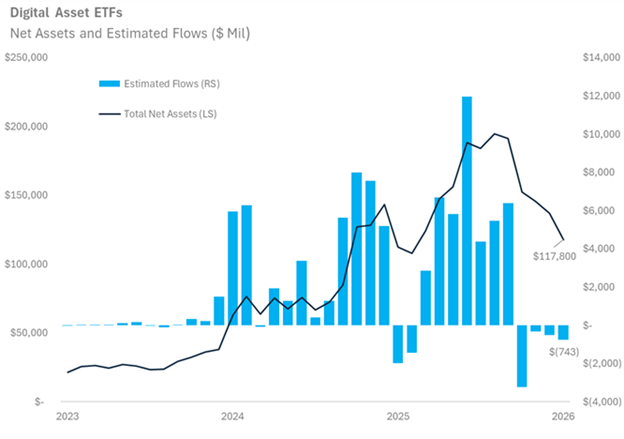
Sources: Carson Investment Research, Factset, Morningstar 2/11/2026
Can Bitcoin go to zero?
A thought-provoking question was raised internally and externally. For reasons I mentioned earlier surrounding AI and quantum computing, the question of cryptocurrency longevity may be higher than usual. Network effects, institutional adoption, total-value-locked, and other use cases still provide significant support for many of the top digital assets. That being said, I would argue part of the risk premium and volatility that cryptocurrencies have over traditional asset classes is the fact that there is a potential, albeit minor, especially for something as well-established as Bitcoin, that a particular digital asset could be rendered useless. There is substantial precedent for this in the space, and I will remind you that there are 33.4 million ‘listed’ cryptocurrencies as of today. Yes, you read that correctly, and the overwhelming majority have no function.
To be clear, we do not feel that Bitcoin, Ethereum, or many of the other top cryptocurrencies have this risk, but it is something considered that is almost never thought of when talking about other markets. Sure, single stocks fail, and single bonds can default, but there is rarely a consideration that either could be completely wiped out (if so, we’d all have more issues).
Conclusion
Crypto winters are just as volatile and can change as quickly as those in Nebraska. The substantial drawdown in many major cryptocurrencies could present a buying opportunity for those with a longer time horizon and a strong stomach, especially when utilized in portfolios in ways that are risk-controlled and frequently rebalanced.
For more content by Grant Engelbart, VP, Investment Strategist click here.
8769104.1. – 11FEB26A