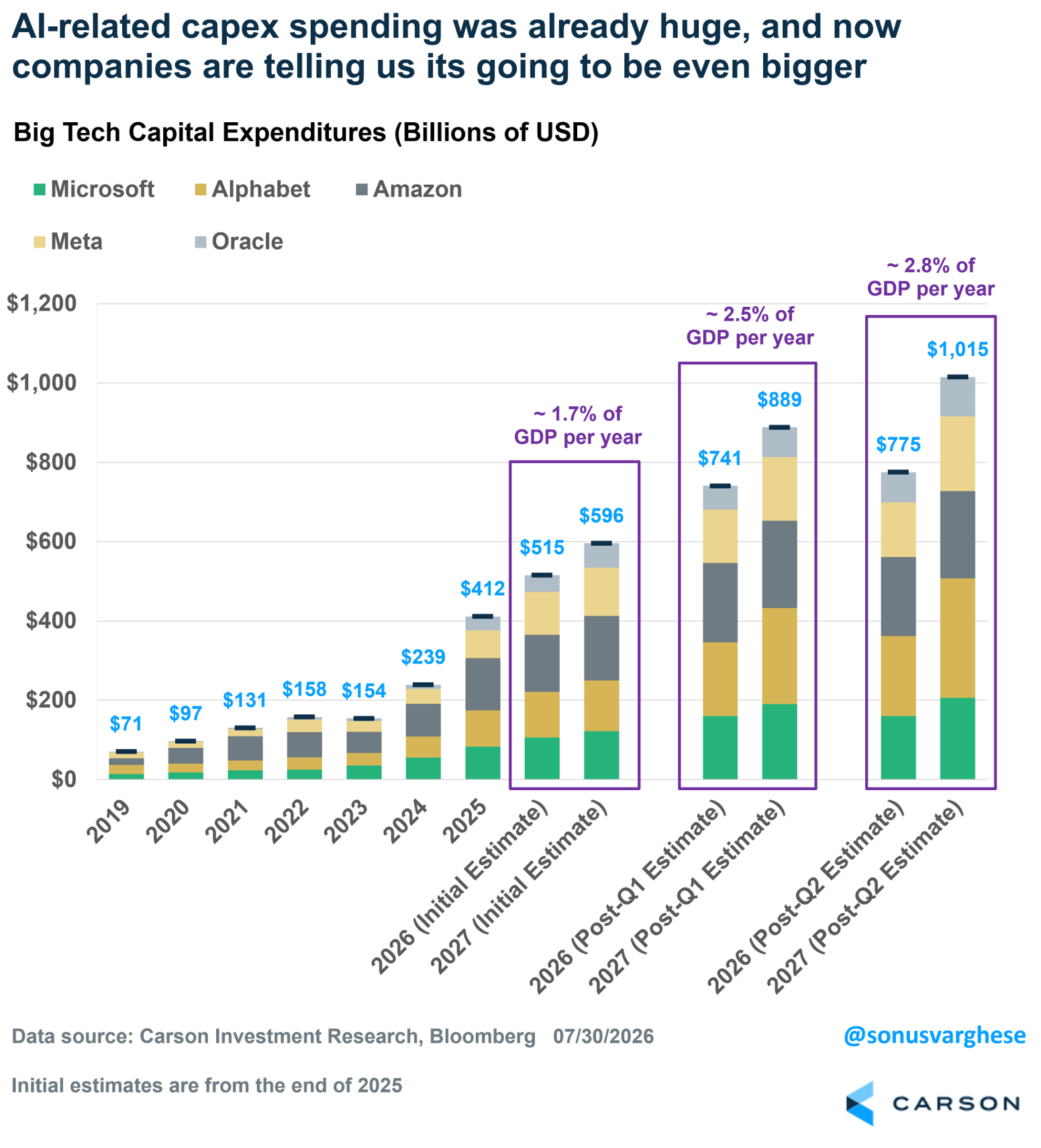
I’ve written a lot about how tech capex spending by the hyperscalers is set to run around 2.5-3% of GDP in 2026 and 2027. What’s striking is how fast the estimate keeps moving higher. Coming into this year, 2026 capex was projected at $515 billion. After Q2 earnings it’s $775 billion, and 2027 is above $1 trillion.
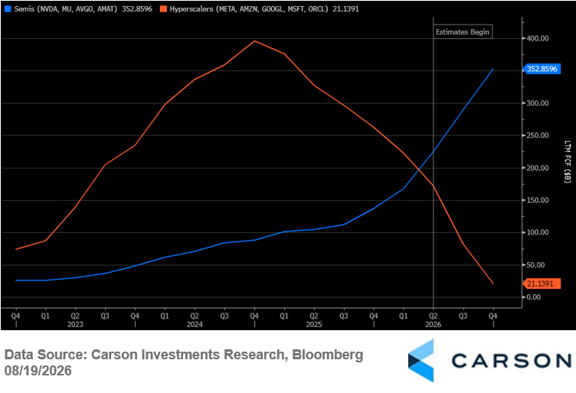
The question is where the money comes from. Up until now these companies had enormous free cash flow to fund the buildout. That’s no longer true, while chip-company free cash flow is surging.
- Hyperscaler free cash flow (Meta, Amazon, Alphabet, Microsoft, Oracle) peaked near $400 billion at the end of 2024, and is on track to be roughly $21 billion by year end.
- The semis on the other side of the trade (Nvidia, Micron, Broadcom, Applied Materials) are running toward $353 billion.
Capex is eating the cash flow of the buyers and depositing it with the sellers. Therein lies the circularity we’ve discussed since last year, including in our full year 2026 Outlook What’s new is Nvidia finding ways to finance the spending beyond simply forking over billions to AI labs.
Nvidia as the Central Bank of Tech Spending?
Jensen Huang made big news early last week, announcing a memorandum of understanding with six major Wall Street players — Apollo, BlackRock, Blackstone, Brookfield, Goldman Sachs, and KKR — to set up “independent compute financing platforms” and raise over $500 billion of third-party capital for the buildout. Note that only one is a bank and the rest are private capital firms and asset managers.
How it works: The platforms lend to the operators building AI capacity, i.e. the “neoclouds,” which are non-traditional cloud companies that build systems solely to train and run AI. The borrowers then spend the proceeds mostly on Nvidia chips. The debt sits in special purpose vehicles. Here’s the important piece: the debt is collateralized by a combination of Nvidia GPUs and offtake contracts.
Commodity finance helps explain that. A mine or LNG plant gets financed on a commitment from a creditworthy buyer, especially if the contract is take-or-pay. Here the output is compute, and the lender’s collateral is the chips plus the contract in a bankruptcy-remote vehicle. The financing rests more on the customer contract than on the chips. That means the credit rating isn’t really about Nvidia, and it isn’t really about the chips, nor the cloud operator. It’s about whoever is buying the compute.
Nvidia’s own role is deliberately limited. Huang described compute as “an investable infrastructure asset” and said Nvidia may provide financing support of “up to 25% of an opportunity.” It’s essentially a residual-value guarantee, deal by deal, with a ceiling around $125 billion. It kicks in only after other recovery steps, such as re-leasing capacity or selling the chips. Hence Nvidia acts as lender of last resort to its own ecosystem. A few caveats:
- Nothing is committed. These memorandums of understanding (MOUs) are non-binding.
- None of the six partners have disclosed a dollar allocation, and no project has been named.
- The $125 billion is a ceiling on agreements that don’t exist yet. Only about $3.5 billion of lease guarantees is contracted today.
Keep the context in mind. Weeks ago, Nvidia was reported to be in talks to backstop $250 billion for OpenAI to lease compute from SB Energy’s Ohio hub, plus another $350 billion of chip purchase financing. Nvidia’s five-year credit default swaps hit 82 basis points in late July versus about half that earlier in the year. That’s classic vendor financing: when Nvidia backstops a customer’s lease directly, it isn’t just providing capital, it’s manufacturing a sale that perhaps wouldn’t clear otherwise. It was creating demand with its own balance sheet.

Stay on Top of Market Trends
The Carson Investment Research newsletter offers up-to-date market news, analysis and insights. Subscribe today!
"*" indicates required fields
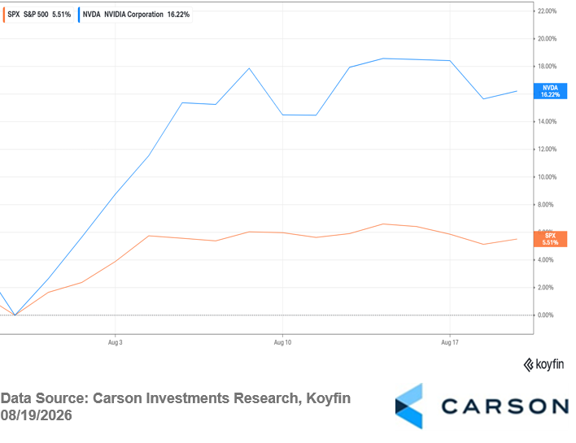
Handing the underwriting to six independent managers changes that. In theory they screen deals on the merits and can decline what Nvidia might have waved through to protect a customer relationship. It transfers tail risk off Nvidia’s balance sheet, which is why credit markets liked it: CDS protection eased to 73 basis points and Nvidia bonds rallied. The stock fell 2.4% on August 10 when the news broke, but it’s up 16.2% from the July 29th low, versus 5.5% for the S&P 500.
Debt Is the Answer, and It’s Already Underway
Going back to my earlier question, the answer to more financing is clearly debt. And this isn’t a 2027 story.
- Incremental debt funded roughly 9% of hyperscaler capex in fiscal 2024, and about 32% on a trailing basis by mid-2026.
- US data center debt issuance roughly doubled to about $182 billion in 2025.
The template already exists. CoreWeave’s $8.5 billion delayed-draw facility from March sits in a bankruptcy-remote vehicle, secured by GPUs and customer contracts, rated A3, priced at about 5.9% fixed, and maturing 2032. CoreWeave itself is junk-rated and its own notes come at 9%. But the collateral is sold into the vehicle in a true sale, so it isn’t part of the estate if CoreWeave files for bankruptcy. That’s how you get investment grade paper out of a junk-rated borrower.
It isn’t the chips doing that work either. A GPU is poor collateral for long-dated debt: Nvidia ships a new architecture roughly every year, the competitive life of a generation is two to three years, and hyperscalers depreciate the hardware over five to six. Three-year resale estimates range from “retains 50-70%” (industry data providers) to “down more than 70%” (the bears, like Michael Burry). Nobody really knows, because the secondary market is young.
What makes it investment grade is the take-or-pay contract, held outside the borrower’s estate, with front-loaded amortization so principal comes back inside the contract term and residual value never has to be tested. That condition is already slipping. CoreWeave’s newest $2.6 billion facility carries roughly a five-year maturity against customer contracts averaging about three years. Whatever is outstanding past year three isn’t backed by an offtake contract at all. It’s a bet on GPU residual value, which is the one thing nobody can price.
So the question that matters is who the ultimate payer is.
- If it’s Microsoft, Amazon, or Meta, it’s probably fine. The paper is a claim on some of the strongest balance sheets in the world.
- If it’s an AI lab like OpenAI or Anthropic, it’s dicier. They have to keep raising capital to honor existing commitments, making this credit deferral rather than credit substitution.
- Oracle is in between: about half of its $638 billion backlog is attributed to OpenAI, fiscal 2026 free cash flow was negative $23.7 billion, and S&P cut it to BBB- in July (one notch above high yield).
None of these mechanics are new, by the way. It’s the same machinery behind commercial mortgage-backed securities, aircraft financing, and energy projects. What’s remarkable is the speed: GPU-backed lending was happening at double-digit yields as recently as 2023, and we’re now at 5.9% investment grade.
Actual Spending Is Even Larger Than the Headline Numbers
Bigger than the CoreWeave deal is Meta’s Hyperion data center: $27 billion of vehicle debt rated A+, priced at 6.58%, amortizing to 2049, with PIMCO taking about $18 billion. Meta keeps 20% of the joint venture, and the debt stays off its balance sheet.
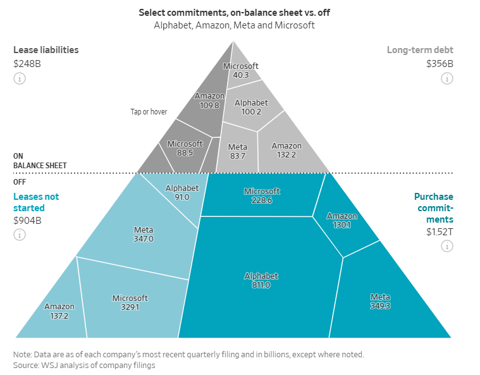
That’s the real story on scale. Big tech’s AI spending is much larger than headline capex because trillions of dollars of future commitments sit off balance sheet. The Wall Street Journal reported that nine major tech companies have roughly $3 trillion of off-balance-sheet obligations, mostly tied to AI infrastructure, versus about $600 billion of reported capex over the past year, and is roughly three times their combined lease liabilities and long-term debt. It comes from two places:
- Leases that haven’t started yet, about $1.2 trillion, which typically stay off balance sheet until the lease begins. Meta alone disclosed $347 billion, with Hyperion the marquee example.
- Purchase commitments, about $1.9 trillion, largely for chips, data center equipment, and energy. These aren’t recorded until the goods are delivered.
- Alphabet is the standout, with commitments jumping to $811 billion from $332 billion three months earlier, some extending to 2054.
This Is Financial Engineering, and That’s Why It Matters
To be clear, none of this means the buildout is fake or the paper is bad. Where the offtaker is a hyperscaler on a firm take-or-pay contract and the loan amortizes inside the contract term, the structure is legitimate and the debt will likely perform. But the character of the buildout has changed. When the marginal dollar of capex is debt-funded, capex becomes sensitive to credit conditions in a way it never was when funded from operating cash flow.
Financing the boom more cheaply, which is exactly what this platform is designed to do, also makes future demand more sensitive to credit volatility. That’s a trade-off, not a free lunch.
It also means two enormous claimants are now competing for the same pool of capital. I wrote yesterday about the other one: a federal government that has already run a $1.8 trillion deficit ten months into the fiscal year and is paying the highest yields at 30-year auctions in 25 years. Add an AI buildout near 2.8% of GDP that increasingly needs to borrow, and a higher cost of capital shouldn’t surprise anyone.
This is no longer a story about one company, or even one sector. The AI buildout can keep going, but it no longer runs on free cash flow alone. As debt replaces cash, the bond market gets a vote. Watch the credit market, not just the chip orders. Equity investors get to be patient about when AI pays off. Bondholders have a maturity date.
For more content by Sonu Varghese, Chief Macro Strategist click here.
9084308.1. – 19AUG26A