
“So, you’re telling me there’s a chance?” Lloyd Christmas in the classic comedy Dumb & Dumber
Now that I have your attention with that title, let’s start with why the rest of 2026 could be strong, then we’ll get into why there could be a lot longer left to this bull market than many may think.
April Is the Key
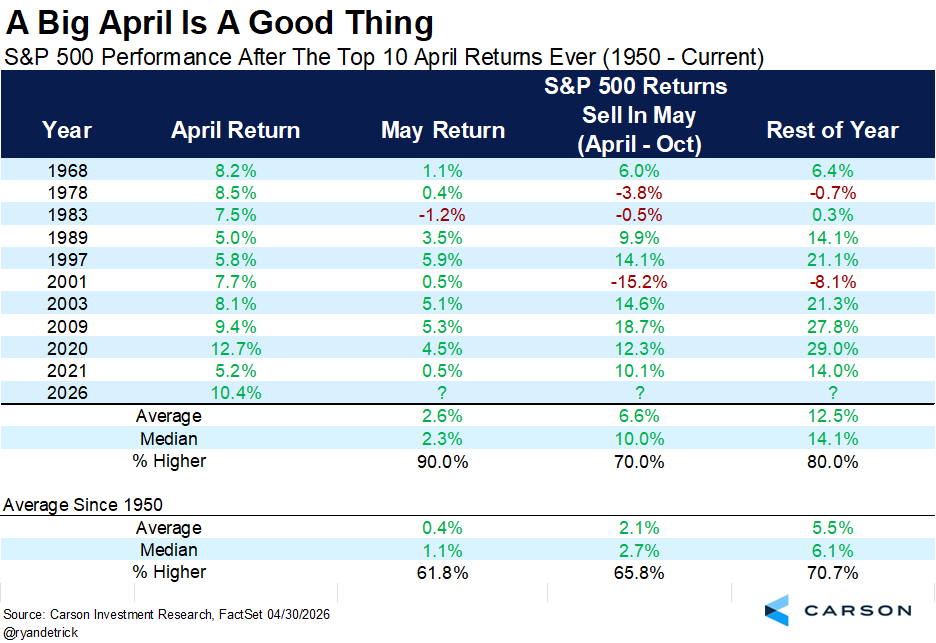
Stocks soared in April, with the S&P 500 up more than 10% for the second-best April return ever. It turns out that a big fourth month of the year has been a clue for future strength. In fact, looking at the 10 largest April returns ever, the month of May was up nine times and the rest of the year was up more than 12% on average, more than double the average return.
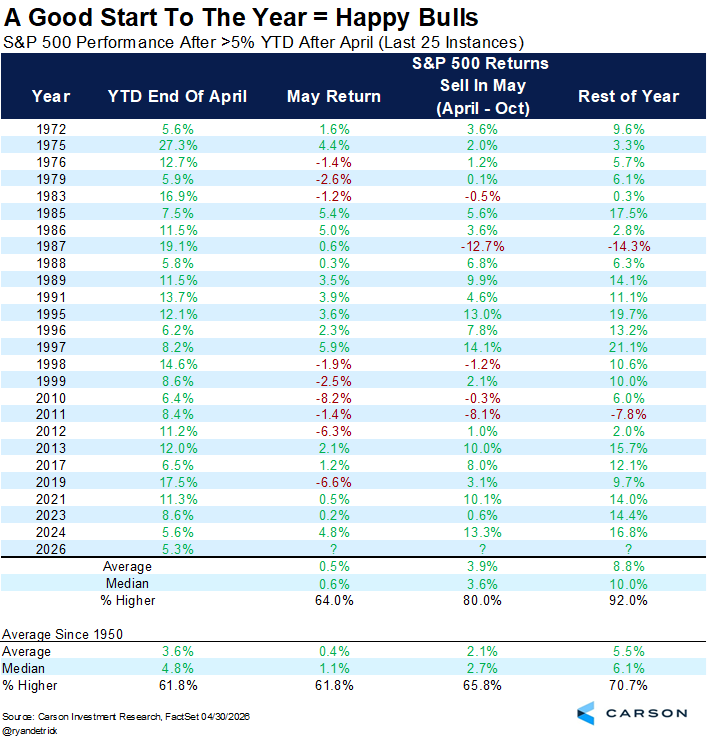
Another angle to look at is when the S&P 500 is up more than 5% for the year heading into May, the rest of the year has been higher an incredible 23 out of the last 25 times.
We’ve remained overweight equities all year and never moved from our S&P 500 target of 12-15% this year, and these two studies do little to change our minds. So that is the rest of 2026, but what about the longer term? There are some clues that say this bull market could potentially have years left.

Stay on Top of Market Trends
The Carson Investment Research newsletter offers up-to-date market news, analysis and insights. Subscribe today!
"*" indicates required fields
The Bull Isn’t Very Old
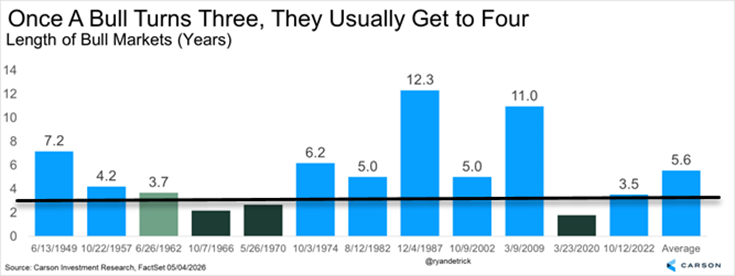
This next chart should look quite familiar to long-time readers. It shows why this bull market might not be as old as you think. We found eight other bull markets that made it to their third birthday, and only once (in the 1960s) did it not make it to a birthday with four candles on it. In fact, the past five bull markets (going back 50 years) that made it to their third birthday lasted an average of eight years, with the shortest still lasting five years. Given this current bull market is three and a half years old, be open to it potentially having many more years.
Up 100%
The current bull market has officially doubled, up more than 100% from the October ’22 lows. If you were around back then, then you know just how incredible this is. We were bullish back then, and we were openly mocked for making such an out-of-consensus call, but here we are.
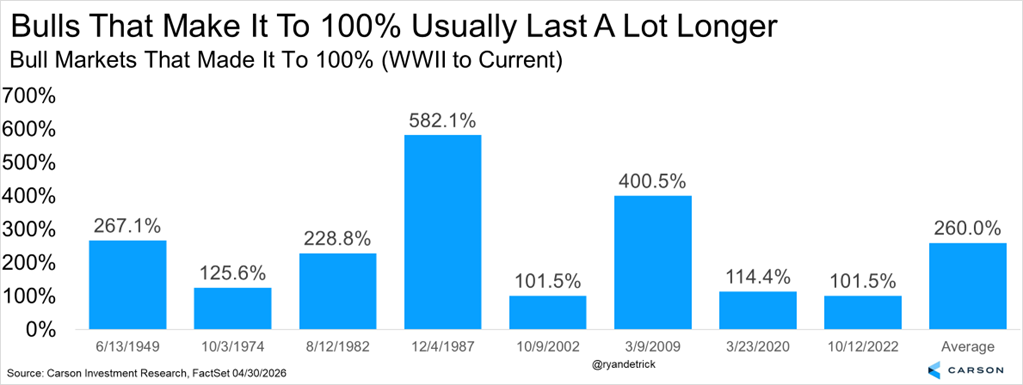
Digging into the data, we found seven other bull markets that made it to 100%, and those bull markets lasted another three years on average, with a median of 1.7 years.
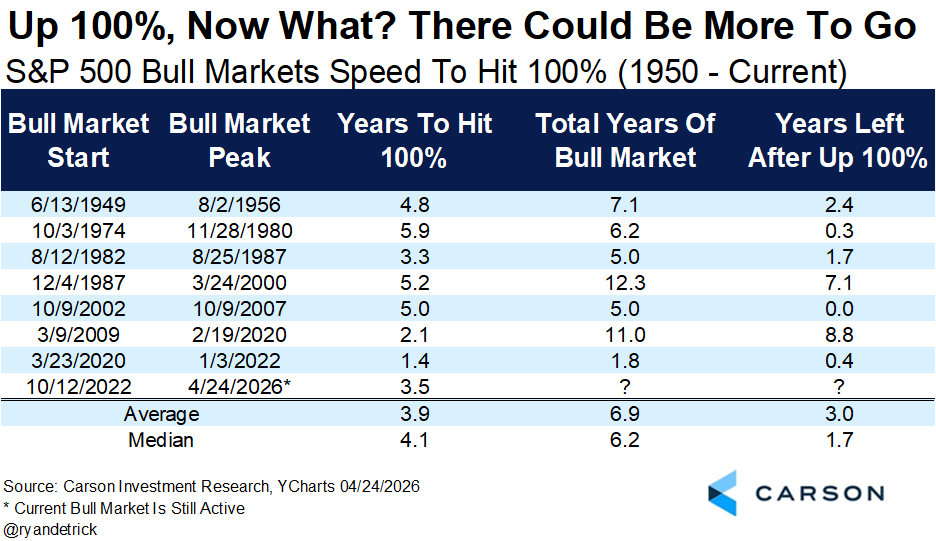
In terms of returns, the average of those seven other bulls was 260% (not including dividends). Yes, the bull market off the March 2020 lows ended at 114%, and the five-year bull from 2002 until the peak in 2007 gained right around 100%, but we’ve seen other bulls last a lot longer.
Maybe There’s a Lot Longer Left?
I’ll leave you with this quite optimistic take. Above, I looked at bull markets by the more traditional definition, where the bull market ends at the peak prior to a 20% decline. We obviously came extremely close to seeing that last year around Liberation Day, but the cyclical bull market survived.
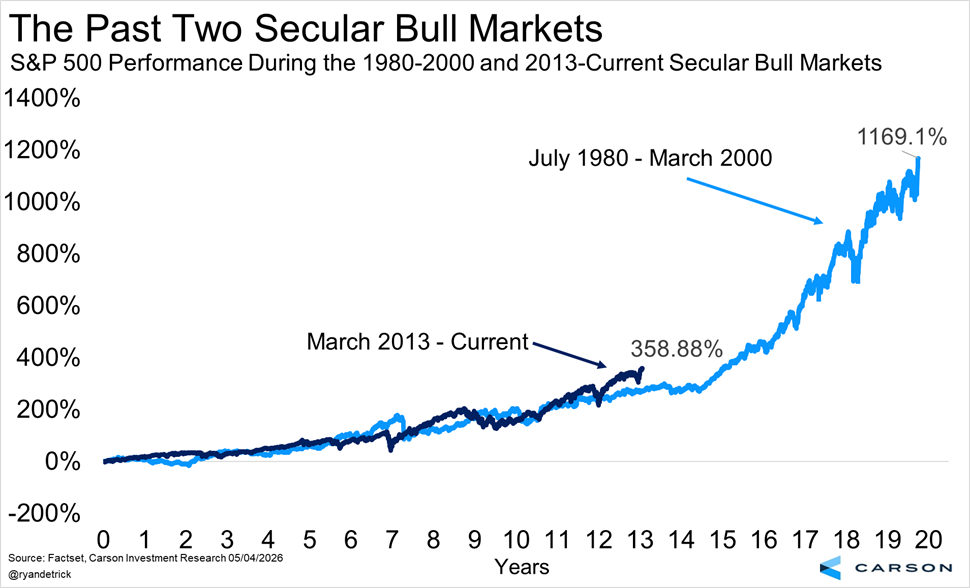
I’ve long been in the camp that we are in a secular bull market that started in 2013 when stocks finally broke out above the 2000 and 2007 peaks. You see, for 13 years, stocks went nowhere, losing more than 50% twice during the lost decade of the 2000s, and once that new breakout happened, we started a new secular bull.
Sure enough, once stocks moved to new highs in March 2013, a new secular bull was born. Yes, we had a near bear market in 2011 and 2018, a 34% bear market in 2020, and then another 25% bear market in 2022. But through it all, we’ve been in a major secular bull market that I’ve long said could last potentially 20 years. I don’t advertise this often, as it truly upsets so many people when they hear it. Well, we are 13 years into this secular bull, and I see no major warnings that it is about to end anytime soon, and I’m open to the idea that it could have many years left.
Let’s compare it with the last major secular bull market for some more clues on how much longer it could last. Many think the bull market of the 1980s and 1990s started in 1982, but once again, I start the clock when stocks break out to new highs after a long time without one, which happened in 1980. It’s the same way I look at things differently compared to those who say the current secular bull started in March 2009. (Again, I’d argue the move from March 2009 to March 2013 was simply part of the secular bear market.)
That prior secular bull market lasted just under 20 years and gained 1,169%, but it saw the crash of 1987 (and eventual 34% bear market), a near bear market of 1990, and a near bear market of 1998 along the way. Who knows if there are another six years left in this secular bull, but as Lloyd Christmas would say, “You’re telling me there’s a chance?” I think there could be.
Thanks as always for reading, and I hope you have a great Cinco de Mayo. Lastly, I was honored to join CNBC’s Squawk Box yesterday to discuss our current views with Melissa Lee and Mike Santoli.
For more content by Ryan Detrick, Chief Market Strategist, click here.
8911767.1. – 5MAY26A