
The holidays are here, and so is the gift that keeps on giving. Traditional mutual funds have enjoyed three strong years of equity market returns and an even longer period of consistent outflows. Taken together, that is a recipe — as good as grandma’s pumpkin pie — for another banner year for capital gains distributions. To make matters worse, these gains sneak up at the end of the year just when investors think they have a grasp on their potential tax situation. Progress has been made with ETF’s as a share class of mutual funds and other potential ways to avoid capital gains payouts, which continue to occur in traditional mutual funds in a big way. To be clear, ETFs are not completely immune from capital gains (or other income payouts taxed in a similar way), but most equity ETFs with scale are able to efficiently manage their portfolios and flows to avoid payouts.
The chart below shows some of our largest legacy mutual fund positions, their expected payouts as a % of NAV, the cut-off dates to avoid those payouts, and a potential ETF replacement. These ETF replacements are not expected to pay capital gains and generally have lower expense ratio than their mutual fund replacement. If the fund names on the left-hand side look similar to those in the past several years, it is because they are. Several of the largest fund companies, some even known for pioneering some of the innovations in the space to avoid capital gains payouts, are once again facing large distributions. It is not to say that these are bad or poorly managed products; in fact it is quite the opposite. Many are among our preferred strategies, but the vehicle the strategy is delivered in is outdated.
The Carson Investment Research newsletter offers up-to-date market news, analysis and insights. Subscribe today! "*" indicates required fields
Stay on Top of Market Trends
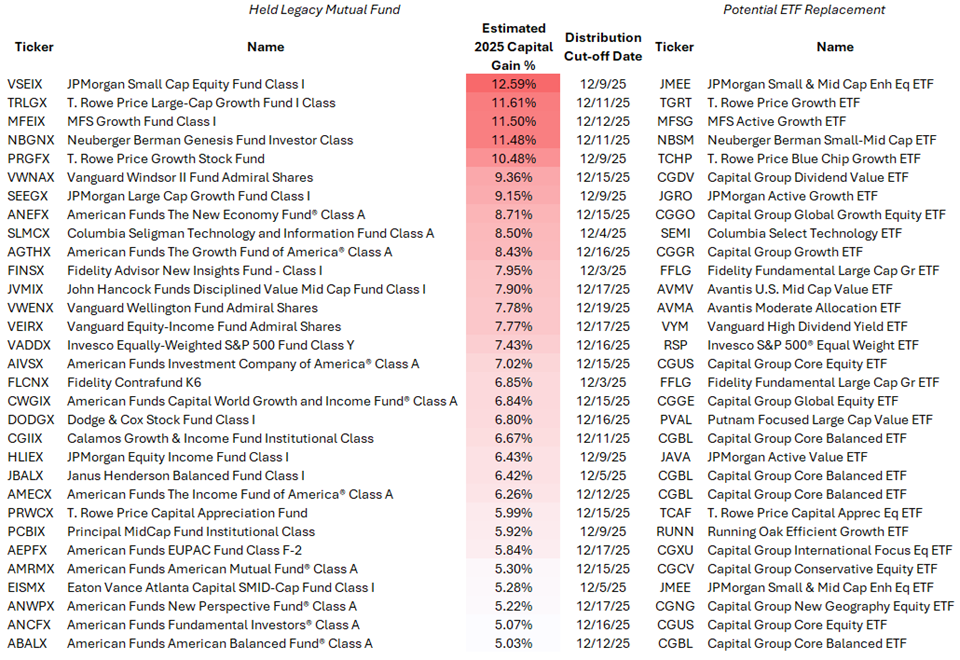
Sources: Carson Investment Research, Morningstar, Blackrock 12/8/2025
On the bright side, what makes this year different than years past is the continued growth of active ETFs, many of which are very similar, if not near-identical, counterparts to their mutual fund version. Assuming the one-time tax hit to switch from the traditional mutual fund to the active ETF is better than the annual surprise of a capital gain, investors can be better served in an upgraded ETF wrapper.
I suspect that next year at this time we will be looking at a similar situation of large expected capital gains (hopefully with market gains to at least have something to show for it). However, there will likely be more active ETFs with more assets — heck, maybe even an ETF share class of some of these funds — and the options for investors will be even better. The irony is, the more active ETFs that launch the more investors move out of traditional mutual funds, leaving the remaining shareholders to foot the bill. (Yes, remaining fund participants are responsible for capital gains on the security sales caused by others leaving the fund.) If you are looking for additional replacement options or a check on your favorite traditional mutual fund please reach out!
For more content by Grant Engelbart, VP, Investment Strategist click here.
8656168.1. – 9DEC25A