Amidst all the drama of the election and the ensuing tech wreck (despite the huge rally on Monday, the technology sector is still from 15% below its October 6th peak), you could be forgiven for not thinking about inflation for a moment. Of course, as my colleague, Barry Gilbert wrote in his election synopsis, inflation was front and center for voters – voters basically told us that inflation remains a burning issue and didn’t think Republicans (who control the white House, Senate, and House) did enough to control it, and exacerbated things with tariffs and the war. However, as I’ve pointed out since the start of the year, the inflation problem goes beyond higher energy prices (due to the war) and higher goods prices (due to tariffs). AI-related bottlenecks have boosted inflation, which is perhaps why a bear case for AI/tech may be a positive for inflation. Still, the inflation problem goes even beyond energy, tariffs, and AI-related bottlenecks. It’s broader.
Headline CPI rose 0.35% in October (4.3% annualized), with prices up 5.7% annualized over the past three months. There are no official year-over-year numbers because of missing data during the October 2025 government shutdown. But averaging September and November 2025 puts CPI inflation at 3.9% over the past year.

Stay on Top of Market Trends
The Carson Investment Research newsletter offers up-to-date market news, analysis and insights. Subscribe today!
"*" indicates required fields
If you think the inflation heat is just about energy, think again. Grocery prices rose at a 5.5% annualized pace in October and 1.7% over the past three months. Seated restaurant prices are heating up too (what the government calls “full service meals and snacks”). I track seated dining because it’s a good gauge of underlying inflationary pressures, combining several drivers:
- Food inflation, and even energy prices (including transportation)
- Rent of restaurant premises
- Worker wages
The data isn’t great. Full-service restaurant prices rose at an 8.1% annualized pace in October, taking the 3-month pace to 5.6% and the 12-month change to 3.8%, above the 2019 pace of 3.3% and inconsistent with “normal” 2% inflation.
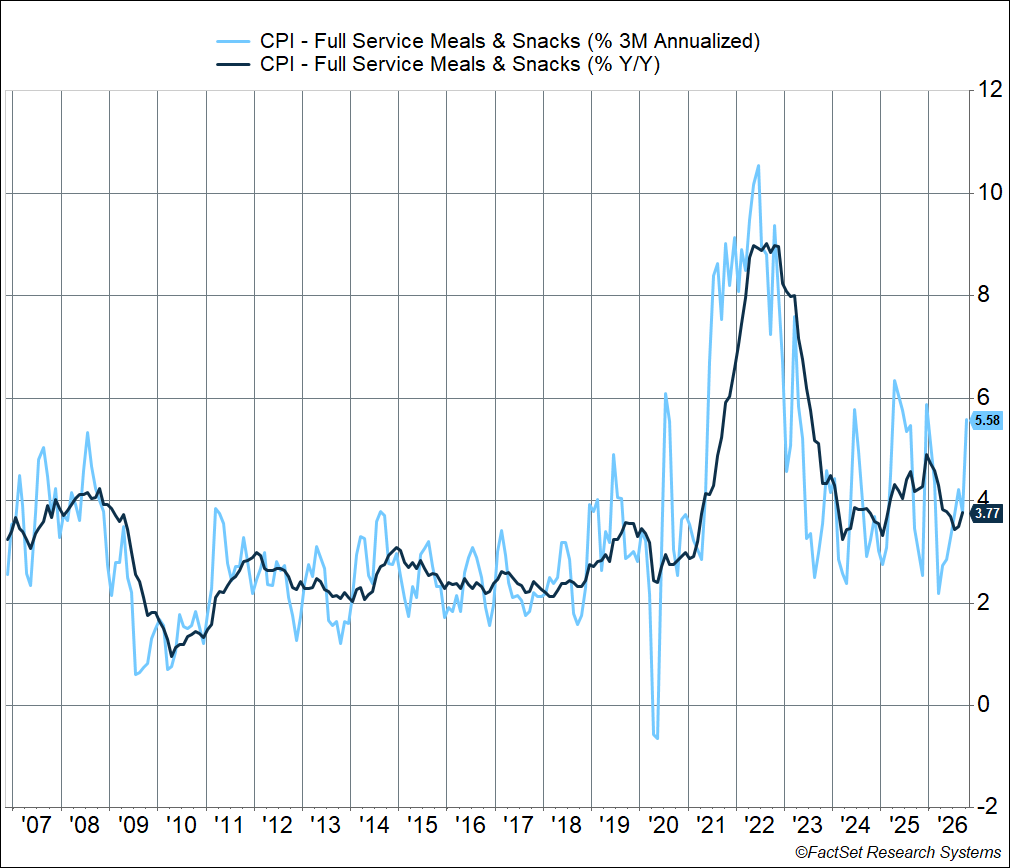
Higher diesel prices amid the Middle East crisis and Russia-Ukraine war are an obvious problem for food transportation, with more likely to come. But restaurant inflation running hotter than groceries suggests other pressures too, including wages amid a stronger labor market.
Even excluding food and energy, core CPI doesn’t look great. It rose at a 3.6% annualized pace in October, near its 3-month run-rate of 3.7% and above the year-over-year pace of 2.8%. It’s worth looking at its three key components.
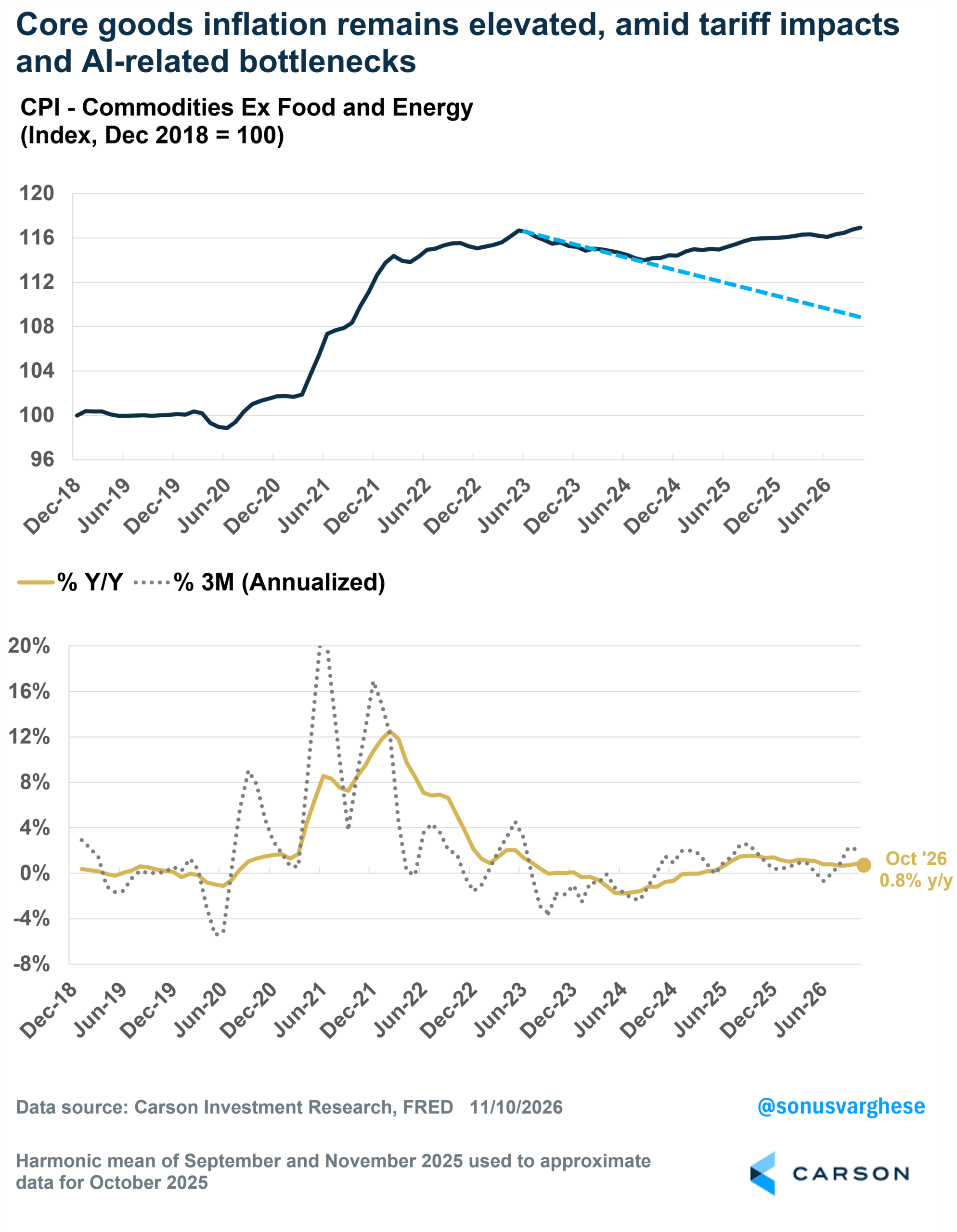
One, core goods prices, including cars, furniture, appliances, apparel, and computers. These prices consistently fell from 1995–2021, before reversing amid the post-pandemic supply chain crisis. They fell again in 2023–2024, moving back toward their pre-pandemic trend. But tariffs and AI-related bottlenecks have pushed them higher for over a year and a half. CPI for commodities excluding food and energy rose at a 1.9% annualized pace in October, taking the 3-month run-rate to 2.1%. Prices are up 0.8% from a year ago. That may not sound hot, but remember that prices were falling before. They’re about 8% higher than if the 2023–2024 decline had continued. Clearly, tariff pass-through to consumers isn’t over.
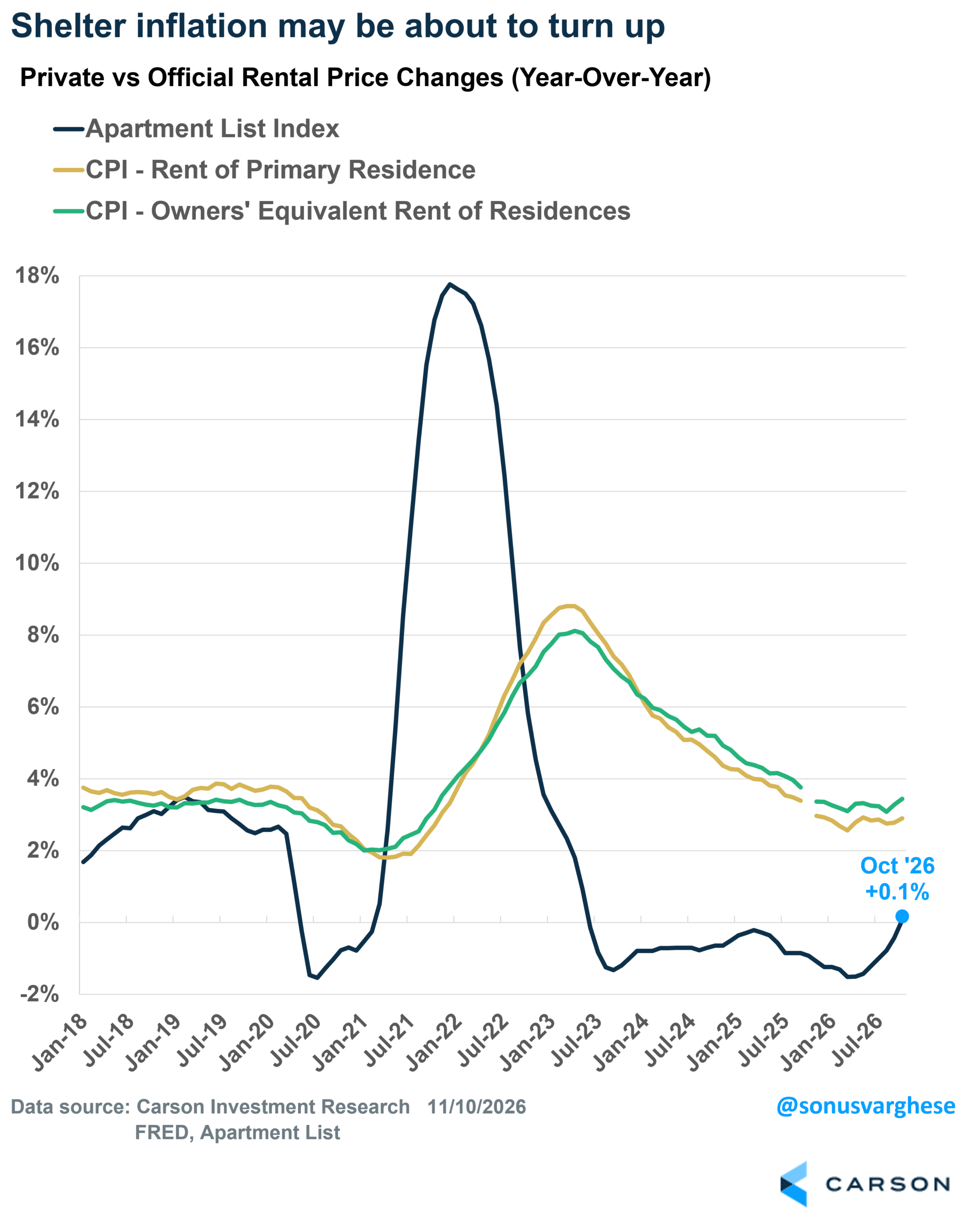
Two, shelter inflation has been a disinflationary tailwind for the last couple of years, across rents and “owners’ equivalent rent” (an estimate of rents homeowners would pay). But elevated mortgage rates are keeping people from buying homes, putting pressure on rents. For the first time in almost three and a half years, the Apartment List rental index shows rents rising from a year ago (+0.1%). Official data lags by over a year, but those numbers are stabilizing and likely to rise next year. That will put more pressure on inflation, especially since shelter makes up over 40% of core CPI.
Three, core services inflation excluding housing (“supercore”) is running hot too. It’s a grab bag, including airfares, hotels, personal care, pet services, and concerts. Supercore inflation rose at a 4.9% annualized pace in October, taking the 3-month pace to 5.4% and the 12-month change to 3.7%. This metric averaged just 2.2% annualized from 2017 to 2019.
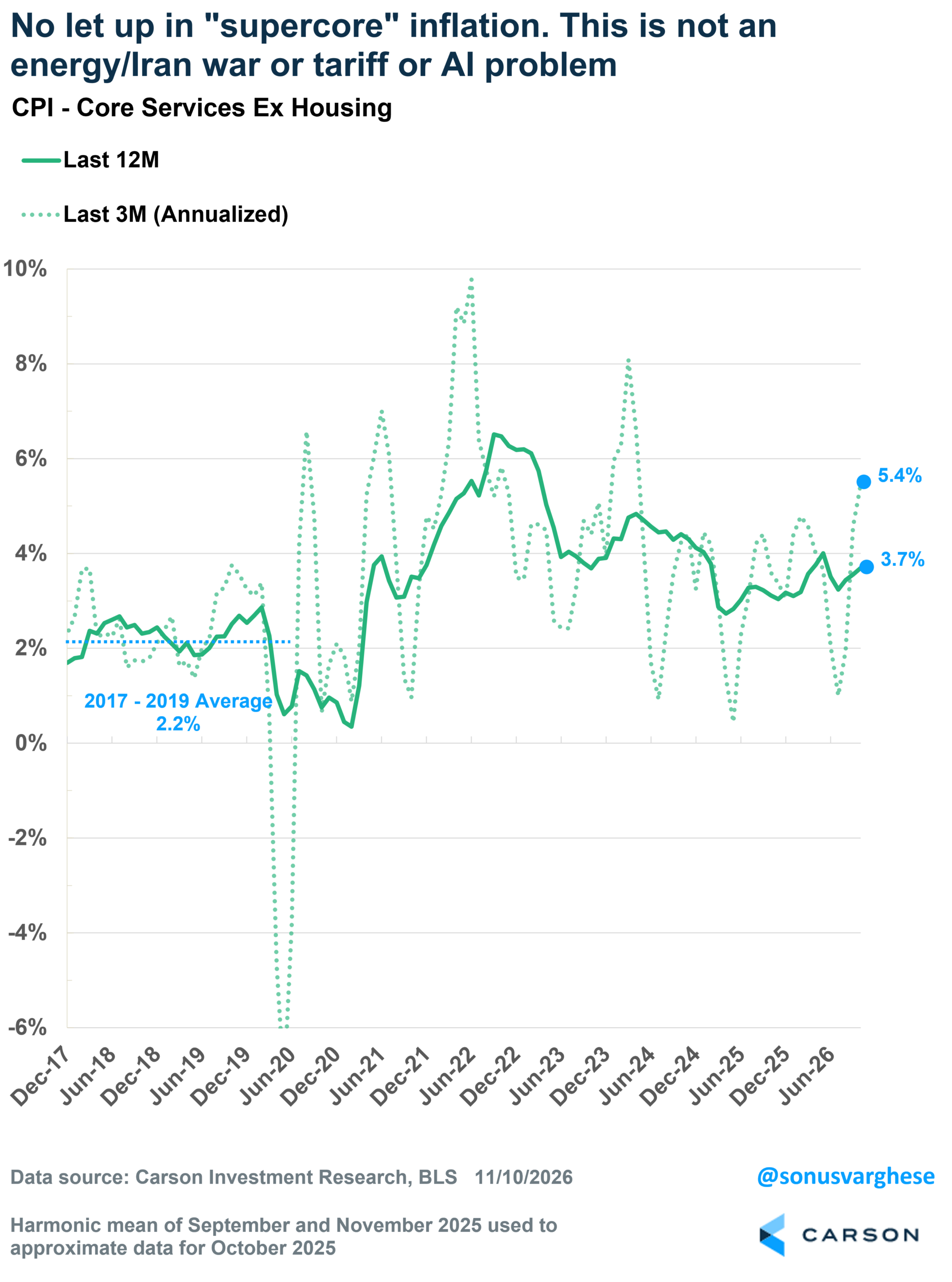
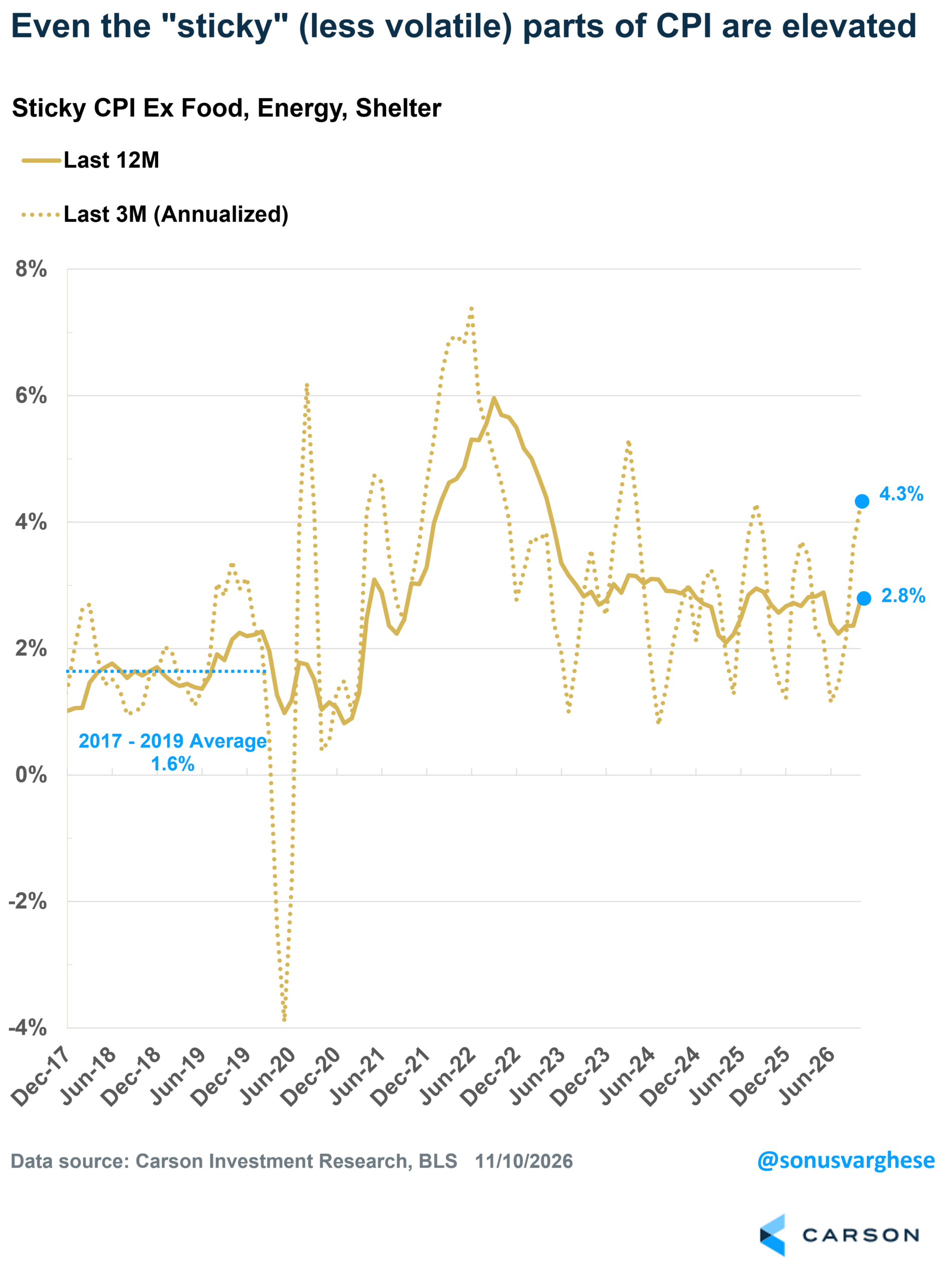
While some of it is obviously tied to energy prices (like airfares), this category is mostly tied to the labor market and wage growth. And as I pointed out in my prior blog, the labor market is looking pretty good. A final cut of the inflation data really underlines the problem. The Atlanta Federal Reserve calculates something called Sticky Price CPI, excluding food, energy, and shelter. It measures inflation for items whose prices typically don’t change frequently. This index rose at an annualized pace of 5.8% in October, taking the 3-month run-rate to 4.3% and the 12-month pace to 2.8%. These readings are well above the 2017-2019 pace of 1.6%.
The big picture is that we’re nowhere close to normal inflation levels. What’s striking is that the Fed seems relatively calm about the inflation picture even though it’s nowhere close to target and doesn’t even look like it’s heading there anytime soon. As I wrote a couple of weeks ago after the Fed held off on raising rates at the October meeting, they seem strangely comfortable allowing inflation (and the economy) to run hot. But that adds to the increasing risk that the Fed falls further behind.
Based on guidance from Fed officials, markets are pricing in three more rate hikes over the next seven months, including one in December. Yet that would take the policy rate to just 4.6%, despite continued strength in the economy. In mid-2023, nominal GDP growth was also near 6%, and unemployment was similar at 4.1%, but inflation was lower (with an arguably better outlook), and the policy rate was 5.4%. So the Fed (and markets) may have to adjust rate expectations higher heading into 2027. The longer the Fed waits, the greater the chance it ultimately inflicts more economic (and market) pain to bring inflation down. What looks supportive for markets today can therefore create the conditions for a much tougher policy response later. That’s the risk of fiddling while the economy runs hot.
For more content by Sonu Varghese, Chief Macro Strategist, click here.
9231337.1. – 10NOV26A