“If I turn out to be particularly clear, you’ve probably misunderstood what I’ve said.” Alan Greenspan
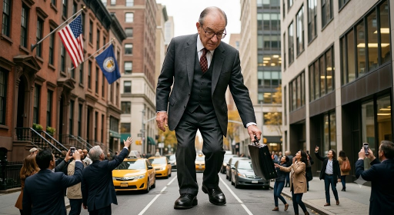
We lost a great one yesterday, as Alan Greenspan passed away from complications of Parkinson’s disease at 100 years young. Greenspan was an economist who served as the chairman of the Federal Reserve Bank (Fed) from 1987 until 2006, serving a total of five terms under four different presidents.
He took over for Paul Volcker in August 1987, which wasn’t the best timing, as the Crash of 1987 was only a few months away. As legend has it, he was on a plane from Washington to Dallas at the time of the crash on October 19, 1987, and no one could even get in touch with him. When he landed and was told the Dow had fallen “five-oh-eight” (508 points or more than 20% in one day), at first he thought it meant the Dow had fallen 5.08 points. Only off by a factor of 100!
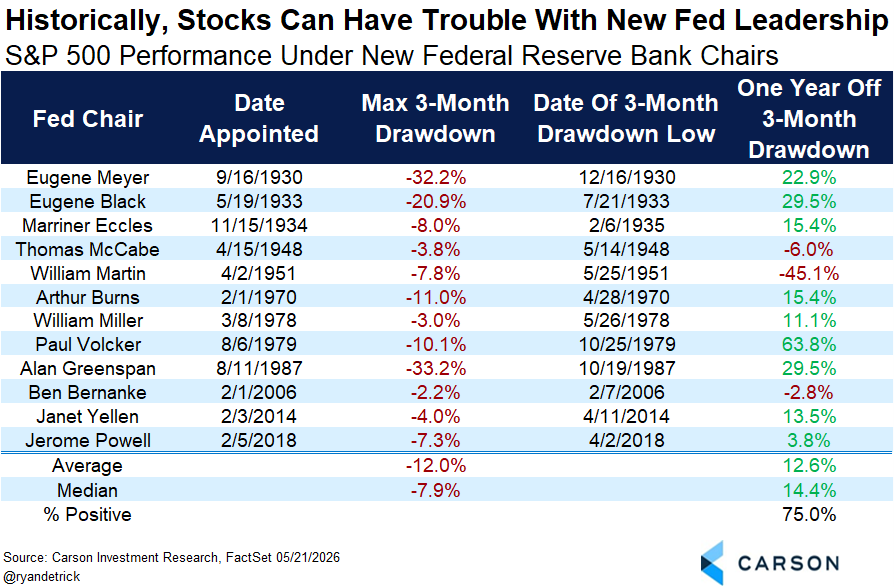
Here’s a chart we’ve shared before showing it’s common to have weakness after new leadership takes over at the Fed, with the 33.2% max three-month drawdown under Greenspan the worst ever.
Greenspan navigated the aftermath of the 1987 crash and the subsequent 1990 recession. But then came the period he is best known for — the incredible go-go stock market run of the 1990s that accompanied the longest period of economic growth in our country’s history, earning him the nickname the Maestro.
And who could forget his ‘irrational exuberance’ speech given on December 5, 1996? Stocks had seen an incredible run already when Greenspan gave a speech at a dinner where he noted reasons stock prices may be getting ahead of themselves. Global markets fell sharply for the next few days. Here’s the quote:
“Clearly, sustained low inflation implies less uncertainty about the future, and lower risk premiums imply higher prices of stocks and other earning assets. We can see that in the inverse relationship exhibited by price/earnings ratios and the rate of inflation in the past. But how do we know when irrational exuberance has unduly escalated asset values, which then become subject to unexpected and prolonged contractions as they have in Japan over the past decade?”
He mentioned in his memoir that the phrase irrational exuberance came to him in the bathtub.😉 So what happened to assets that were potentially pricey after one of the smartest men alive, with more information than nearly anyone, flashed the warning sign? We saw one of the greatest three-year rallies ever, with the S&P 500 more than doubling into March 2000, while the Nasdaq gained close to 300%!
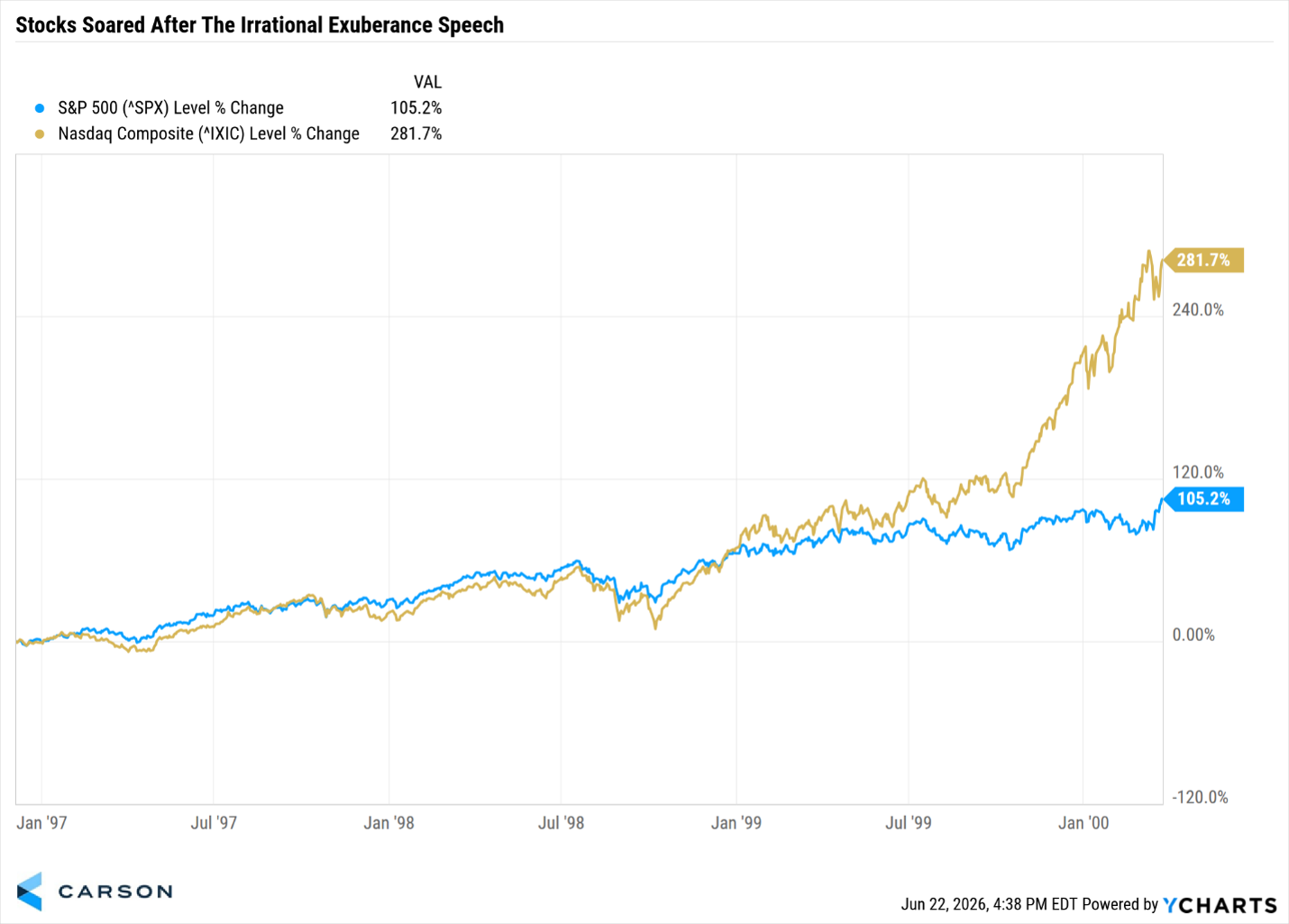
There’s a lesson in that for where we are now. Yes, markets have been good, but we don’t think we are in a bubble now, although there are clearly some areas that have seen incredible moves and could be due for potential volatility at any time. But look at the type of move we saw for multiple years at the end of the 1990s. That’s why we suggest riding this wave for potentially much higher prices, but don’t go overboard and remember to remain diversified.

Stay on Top of Market Trends
The Carson Investment Research newsletter offers up-to-date market news, analysis and insights. Subscribe today!
"*" indicates required fields
Greenspan was a larger-than-life legend by the late 90s and could do no wrong in the eyes of many, but like any good story, he had a downfall soon after. Of course, stocks eventually peaked in early 2000, and the tech bubble burst, with the first three-year losing streak for the S&P 500 since the Great Depression. Stock prices were cut in half (with the Nasdaq down more than 80%). Greenspan then cut rates and left them low for many years, which today many say contributed to the housing bubble and eventual Great Financial Crisis. He stepped down in 2006 and handed things off to Ben Bernanke, another rather nicely timed handoff before historical trouble.
In the end, Greenspan was in charge of the Fed for 18 years and saw the S&P 500 gain an incredible 290% during his tenure. Both results are second only to William Martin. His impact on Fed policy is undeniable, even if his legacy is a tad more murky.
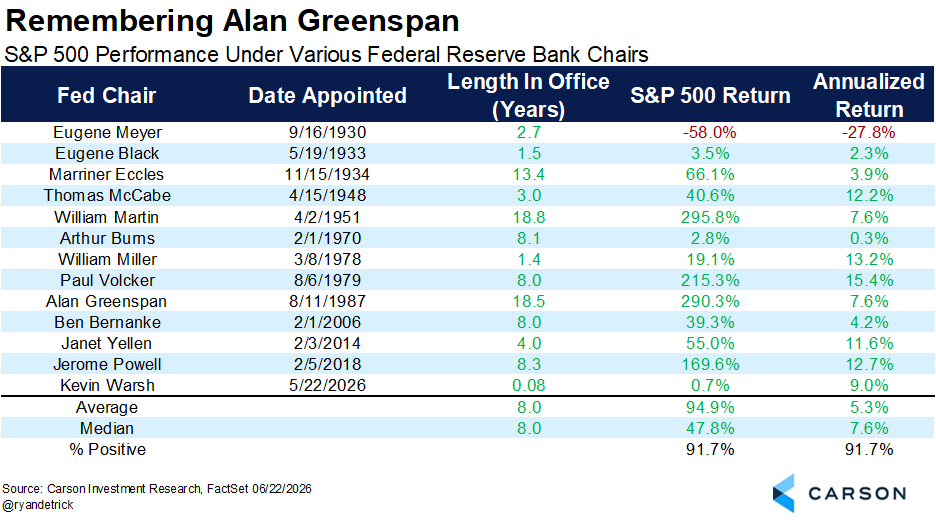
Thanks as always for reading, and for more of our thoughts on new Fed chair Kevin Warsh, be sure to read Mixed Messages From the Fed Even as the Economy Runs Hot.
For more content by Ryan Detrick, Chief Market Strategist, click here.
8989641.1. – 23JUNE26A