
The semi-annual FTSE Russell reconstitution occurs today. This reconstitution welcomes new companies into well-known indices, such as SpaceX into the Russell 1000 index. It also reshuffles companies between value and growth indices, such as Micron and Amazon transitioning in opposite directions.
Micron Leaves Value
Micron’s business has undergone a fundamental boom, and price momentum has followed. As I wrote about, the company’s revenue surprise last quarter eclipsed Nvidia’s revenue surprise. And the company continued that trend with this most recent report. However, investors’ expectations have ballooned along with the meteoric rise in Micron’s fundamentals.
As shown below, Micron’s book value has never been higher since 1998. Micron’s trailing price to book ratio of nearly 19x is substantially higher than the Russell 1000 Value index’s price to book value of roughly 3.5x, and is even higher than the Russell 1000 Growth index’s price to book value of roughly 12.5x.
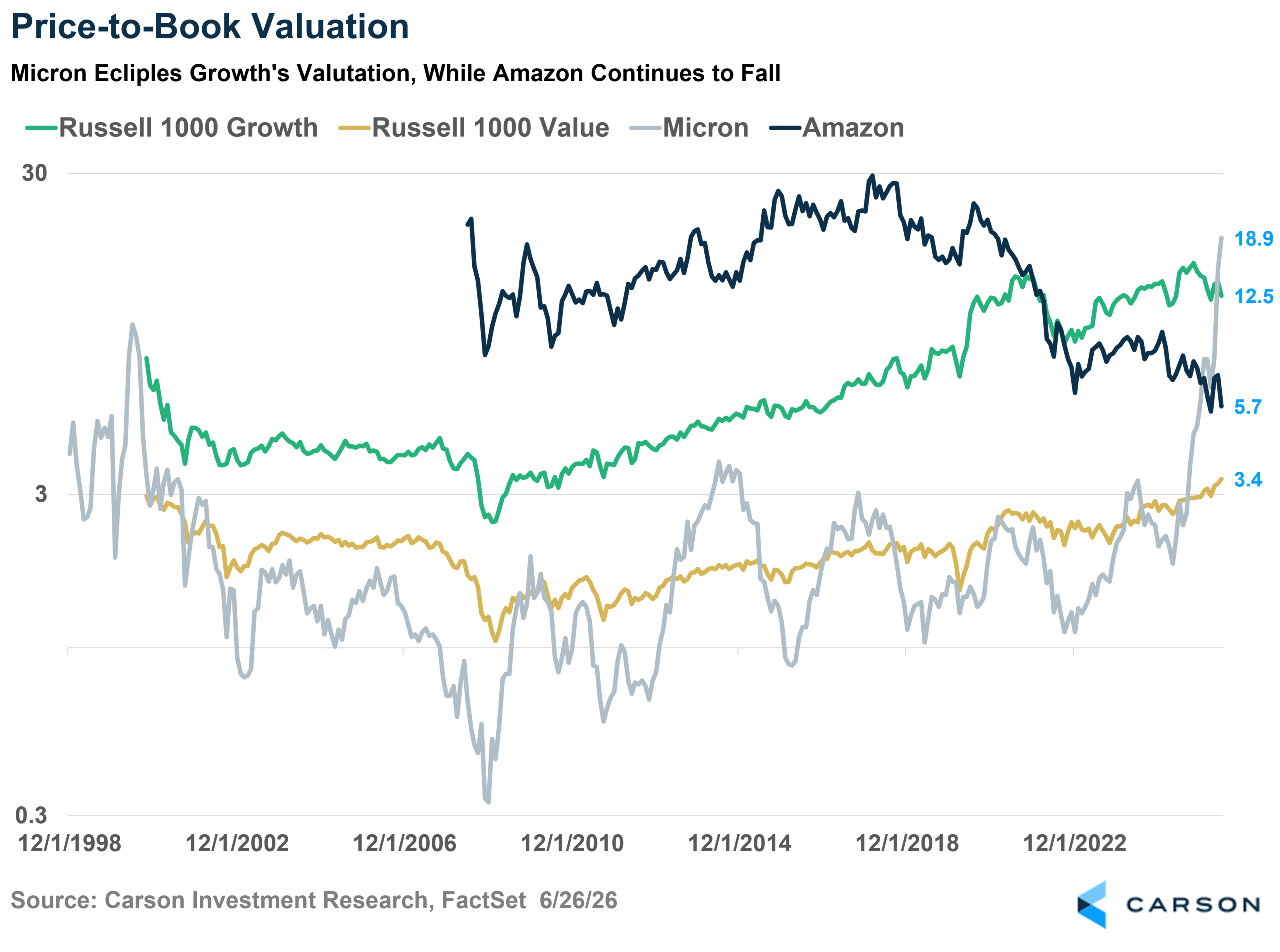
The chart also illustrates well how investors may have been anchored to treating Micron as a ‘Value’ company. Between the years 2000 to 2024, Micron never traded at more than twice the book value of the Russell 1000 Value index, but also rarely less than half the index’s ratio. Said differently, Micron traded in a tight range around the Value index’s valuation as investors perceived the company as cyclical.

Stay on Top of Market Trends
The Carson Investment Research newsletter offers up-to-date market news, analysis and insights. Subscribe today!
"*" indicates required fields
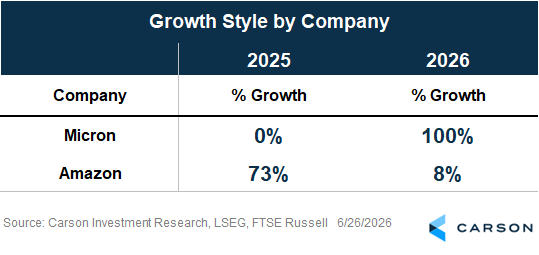
But times have changed. Thanks to AI, investors may be expecting Micron to produce secular, not cyclical, results. Micron’s current book value, justified or not, looks like a growth stock and is enough for the Russell US Indices to change their classification. Effective today, Micron goes from being 100% allocated to their Value index, to being 100% allocated to their Growth index, as shown below. Valuation isn’t the sole criteria for classification – Russell also uses historical sales per share growth and forecasted growth – but price to book is a dominant factor.
Amazon Leaves Growth (Mostly)
On the other side of the ledger is Amazon. Amazon, as shown above, is transitioning mainly from being allocated to Growth, to nearly entirely in Value. Unlike Micron’s booming valuation, Amazon’s price to book ratio has never been lower. Amazon’s current 5.6x price to book value is below the 8.2x trough of this valuation metric seen during the 2008 crisis. And ever since first trading ‘cheaper’ than the Russell 1000 Growth index for this metric in early 2022, Amazon has not traded above the index.
Taken as a whole, this Russell style reconstitution reflects a deeper change than relative share price returns. Micron was treated by investors for decades as a cyclical value stock whose worth was anchored around book value. But AI has altered that perception, at least for the time being, with Micron now exiting one of the largest Value indexes. Amazon, on the other hand, was highly valued by investors as it expanded its reach across markets. But it has lost its luster, at least for now, as it transitions from Growth to Value.
For more content by Blake Anderson, CFA®, Director, Portfolio Management, click here.
8996627.1. – 29JUNE26A