
“Bull markets are like a cruise ship—once they get moving they are hard to slowdown and very hard to turn around.” Ryan Detrick, Carson Group’s Chief Market Strategist
Can you believe it? The bull market turns three this Sunday. It might feel like a lifetime ago, but three years ago right now stocks were down 25% and in the depths of a vicious 10 month bear market. Investors may forget this now, but most of the high-flying technology and AI leaders right now were actually cut in half or more back in 2022. Many might recall the bear market of 2022 as a minor blip after the rally we’ve seen, but for those of us that were there, it wasn’t a fun time for investors. Interest rates soared, the Federal Reserve was hiking rates unlike anything seen in a generation, and inflation was rampant. Then a funny thing happened—stocks bottomed and have been climbing ever since.
Yes, the huge excitement over AI has been a big driver, but so has an incredibly resilient consumer, strong household and corporate balance sheets, inflation coming back to earth, a now dovish Fed, and record profits and profit margins. I went on record in November 2022 that the lows were in and a new bull market was upon us. That was universally hated and mocked. Everyone (and I mean virtually everyone) said a recession was certain and the bear market was far from over. Thankfully, we stuck with our process, took a lot of arrows for going against the crowd, but as a result have greatly helped our Carson Partners and their clients.
Happy Birthday!
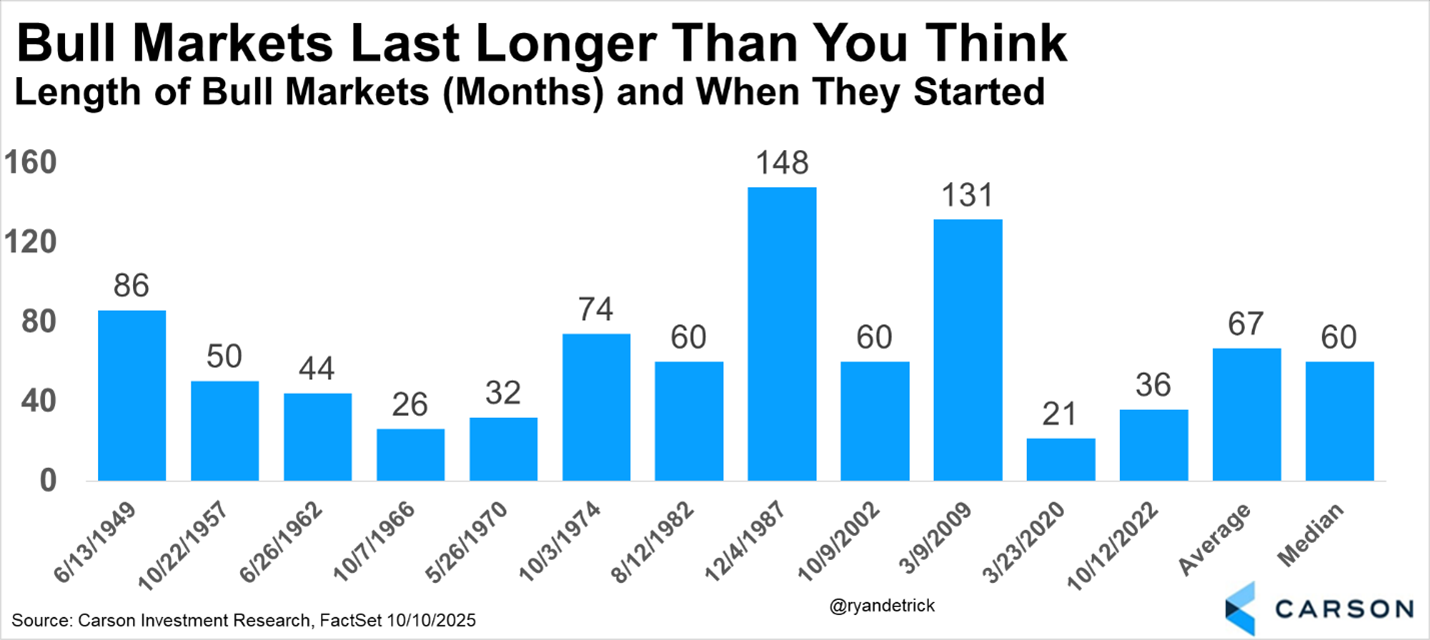
For those of us getting older, we like to say that age is just a number. Bull markets like to say that as well. In fact, looking at the 11 bull markets since World War II, the average one lasts more than five years.
Looking at the returns, this bull market is up a very impressive just under 90% in three years. That sounds like a lot, but then you see the average bull market since WWII gained more than 191% and again it puts in perspective that this bull market might be younger than many think, and more gains could even be likely.

The quote above about a cruise ship is one I’ve been using for well over a year now. When the bull turned two we noted that the likelihood of the bull market reaching its third birthday was quite high. Well, now we are saying we bet it makes it to at least four.
Now What?
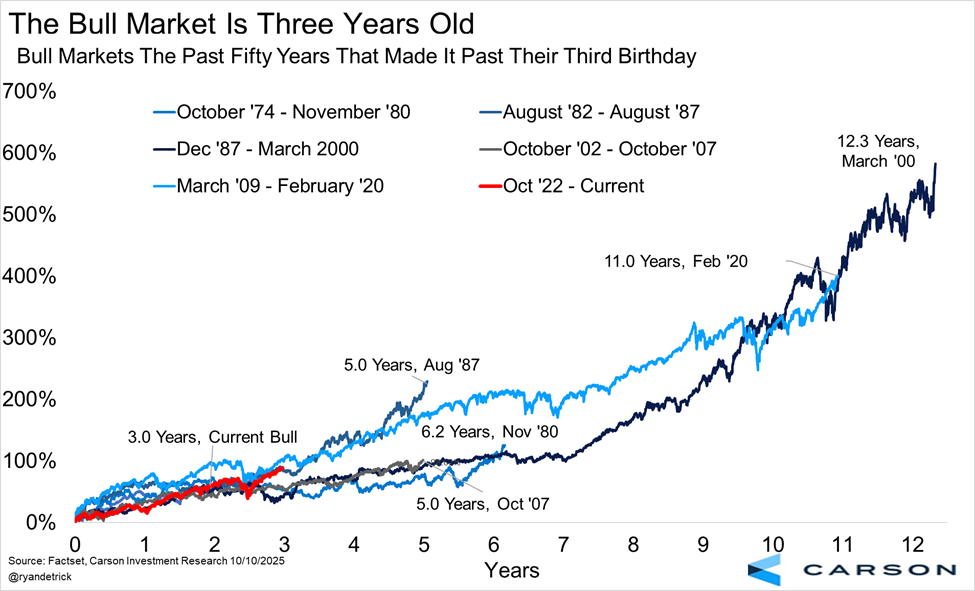
Going back fifty years, we found five other bull markets that made it this far. You know what happened with those bulls? They all lasted many more years, with the shortest bull market five years, two lasting more than a decade, with an average length of eight years for the five. No, we aren’t saying this bull has another five years left to it, but we are saying be open to the possibility that this bull market could have much longer left to it than you probably think.
This chart is one we’ve shared many times, as it is quite powerful and truly lives up to the expression that a picture is worth a thousand words.
What About Year Four?
One thing we were on record of at the start of 2025 was to be on high alert for some volatility. We didn’t know it was going to be the near bear market around Liberation Day that did it, but the odds were high for as much as a 15% correction in our eyes. We noted many times that early in a post-election year you tended to see weakness, not to mention the third year of bull markets tended to be choppy and frustrating. It all suggested to us some type of shake the tree moment was likely the first six months of 2025.
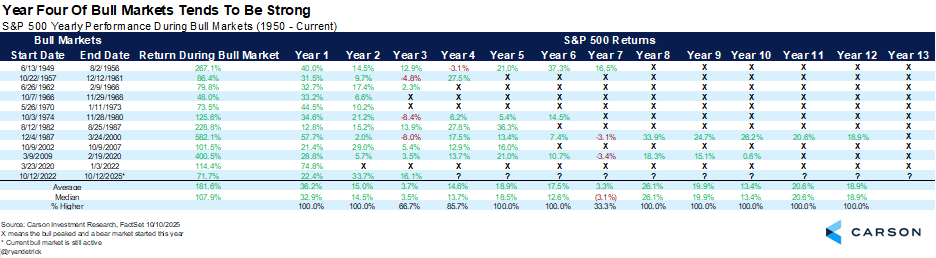
Clearly we saw that volatility and then some, after one of the two sharpest sell-offs in history in April that saw stocks down nearly 20%. But what could be next? The good news is the fourth year of a bull market tends to be quite strong, something we think could happen once again over the next 12 months.
More Good News
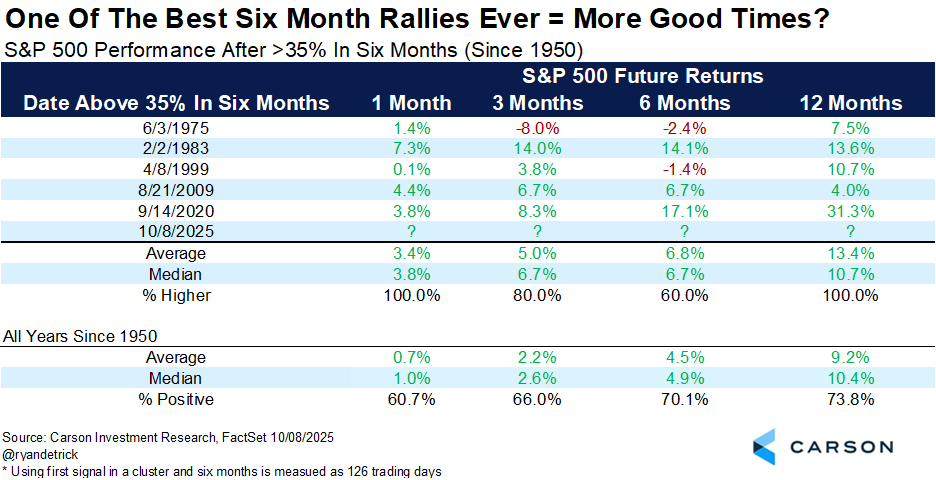
Lastly, stocks just had one of their best six-month rallies ever, up more than 35% in only six months. Yes, near-term we wouldn’t be shocked at all if we saw a well-deserved pause after this huge rally and the current five-month win streak, but bigger picture, this type of strength isn’t what you see at the end of bull markets.
We found only five other times going back to 1950 the S&P 500 was up more than 35% in six months (using the first signal in a cluster). Strong than average performance is perfectly normal over the coming 12 months, but a year later stocks have never been lower and higher more than 13% on average, which should comfort many nervous bulls who think this may be a blow off top.
If you’ve read this far, I thank you! We won’t always be right, we won’t always be wrong, but the Carson Investment Research team will be honest, actionable, and always there every single day. For more of latest thoughts on markets and the economy, please check out our most recent Facts vs Feelings below.
8487994.1.-10OCT25A
For more content by Ryan Detrick, Chief Market Strategist click here