
Financial stocks have gotten off to a rough start in 2026. While some are raising alarms about deteriorating credit conditions or systemic stress building beneath the surface, the sector’s recent struggles may be tied more to technology. Beneath the headline weakness, the structure and drivers of financial sector performance have evolved in ways that challenge traditional interpretations and may ease the worry of concerned investors.
One of the most important shifts is the composition of financial sector exposure itself. The State Street Financial Select ETF – XLF – is no longer a pure play on traditional banking activity like lending margins and credit cycles. Instead, it has increased its exposure toward companies with more ‘tech-like’ business models in recent years with addition of Visa and Mastercard in March 2023. Firms like these benefit from high margins, scalable platforms, and relatively predictable revenue growth akin to technology companies. These stocks have struggled so far this year as a move upward in bond yields has challenged the earnings multiple investors are willing to pay for these stocks, among other factors.
At the same time, more traditional large financial institutions have been steadily increasing their exposure to the technology ecosystem. Firms like JP Morgan and Goldman Sachs have expanded into lending for technology infrastructure, including financing data centers and AI-related projects. They are also positioning themselves to play key roles in capital markets activity tied to the next wave of high-profile technology IPOs. Potential listings from companies like SpaceX, OpenAI, and Anthropic represent not just underwriting opportunities, but also deeper integration between financial firms and the innovation economy. In my opinion, it may appropriate to label these firms as having high ‘tech-related activity’ given how much of their growth may be dependent on the adoption of technology.
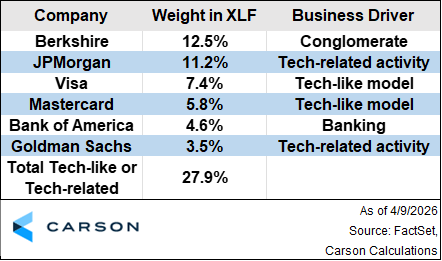
This dual shift – toward tech-like constituents within the sector ETF and increased tech-related activity within banks – means that financials are more correlated with the technology sector than in prior cycles. As shown below, roughly 28% of XLF is comprised of tech-like or tech-related companies in my estimation. In other words, weakness in XLF may be reflecting equity market dynamics rather than signaling stress in lending or balance sheets.

Stay on Top of Market Trends
The Carson Investment Research newsletter offers up-to-date market news, analysis and insights. Subscribe today!
"*" indicates required fields
Looking more closely at credit-sensitive segments of the market reinforces this idea. ETFs such as the SPDR S&P Bank ETF (KBE) and the SPDR S&P Regional Banking ETF (KRE), which are more directly tied to traditional banking operations, have a positive return so far in 2026 as shown in the chart below. These institutions are typically the first to feel pressure when credit conditions deteriorate. If investors were truly concerned about rising defaults, tightening liquidity, or systemic risks, these stocks would likely be under significant pressure. Instead, their relative strength suggests that credit conditions remain stable, if not outright supportive.
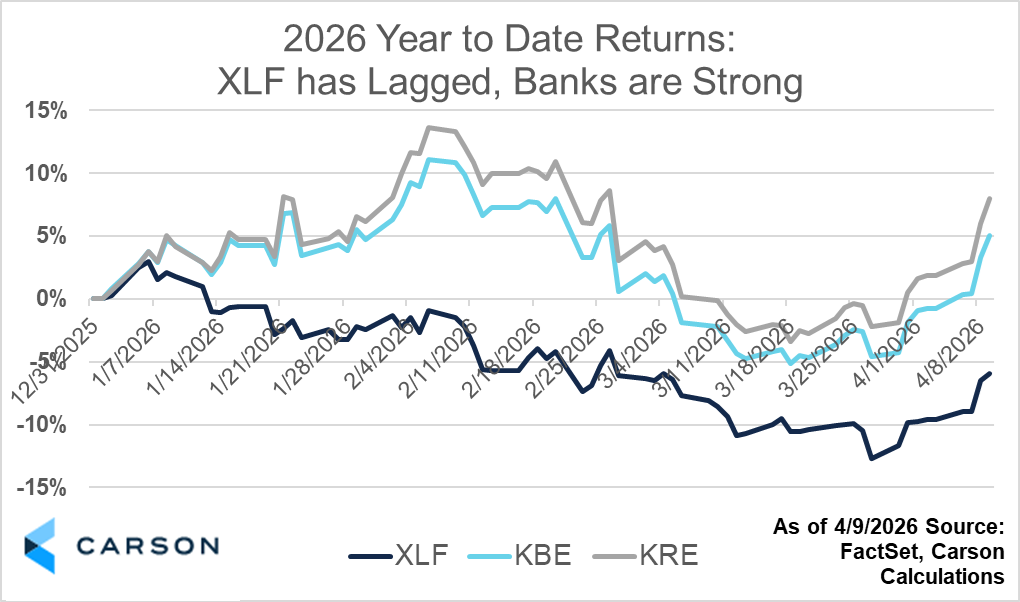
Taken together, the market’s message appears more constructive than the headline performance of XLF might suggest. Financials are struggling, but for reasons that are increasingly tied to their growing overlap with technology rather than a breakdown in credit fundamentals. Meanwhile, the resilience of traditional banks points to a backdrop where lending conditions remain intact and potentially conducive to continued economic growth. If there were meaningful credit concerns brewing, investors would likely be punishing these companies far more aggressively—but that simply hasn’t materialized.
For more content by Blake Anderson, CFA®, Director, Portfolio Management, click here.
8871481.1. – 13APR2A